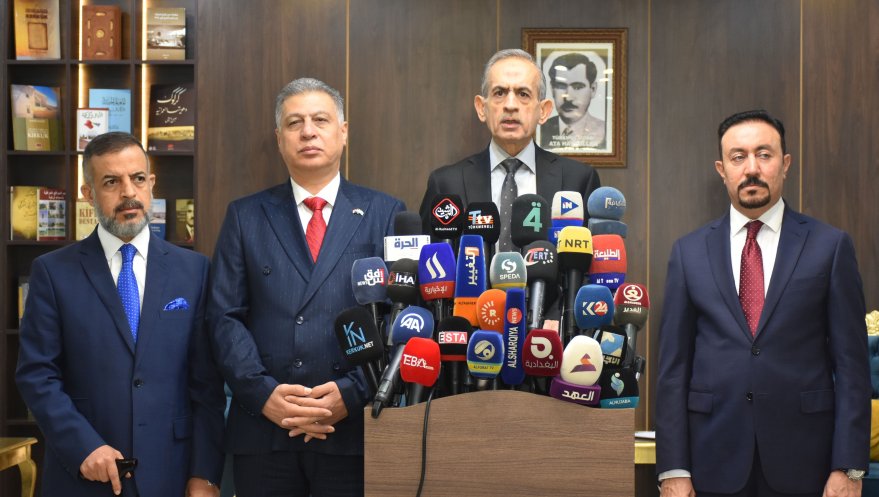
Hydropolitics specialist Dursun Yıldız, who answered the questions of ORSAM Water Research Programme, made some evaluations on the issues related with the Turkey's trans boundary water policy, the water transfer projects, the disputes on Ilısu Dam, the relationship between EU Water Framework Directive and water management in Turkey, the water-based cooperation in Middle East and conflict potentials. Yıldız underlined the fact that Turkey never used her transboundary waters for peaceful and cooperative objectives. He told that “But Turkey should do something beyond this. She should guide the neighboring countries in terms of the techniques and planning.''
ORSAM: Could you please tell us briefly about yourself?
Dursun Yıldız: I was born in Samsun in 1958. I am civil engineer and also expert of hydro politics. I had worked in the various departments of DSI General Director for 25 years as an engineer, a branch director and a head of department then I retired in 2007. In this duration, I joined to the postgraduate technical education and application programs on the scope of water engineering in Holland and USA. Also, I got the master's degree on Hydropolitics in Hacettepe University Hydropolitcs Strategic Research Centre. In addition, I completed a certificate program on EU Specialty and International Relations in Ankara University European Union Research and Application Center. In some periods, I became the member of management board and secondary director in TMMOB and the Chamber of Civil Engineering. I gave lectures as a part-time instructor in Hacettepe University Hydropolitics and Strategic Research Center and Gazi University Engineering and Architecture Faculty. I still continue to work on water resource and politics and keep on implementing my own engineering and consulting firm.
What is hydropolitics ?
As you know, although water is seen as a globally unending source, it is such a finite one in terms of qualitative and regional. Also, it spreads around the world unequally in time and space. Especially fresh water resources became as not fulfilling the needs of people in some parts of the world after the second part of the 20thcentury with the increase in population and pollution. Through the 20th century, number of the independent states had increased so transboundary rivers also increased too. Therefore, 145 countries began to stay in those transboundary river basins and %40 of the population began to live in these transboundary river basins. After these events, pressures on water issues began to cause serious problems both internal and international affairs of the states.
By the beginning of 20th century, problems emerged in terms of supply and allocate of international and transboundary water resources. These events resulted in the emergence of ''Hydro politics'' as a new international political concept and discipline.
After this introduction, we can define hydropolitics as an interdisciplinary scientific branch which analyzes the relationship based on interest on use of transboundary water resources and assess the implications on water to take socio-economic, political and judicial precautions.
Within this context, how do you evaluate hydropolitics of Turkey?
This issue can be analyzed in two parts as before and after Cold War periods. We can say that Turkey's hydropolitics as related with Turkish Foreign Policy was stable in Cold War era as compared with current situation. Her foreign policy was based on security issues especially in the relations with neighbors because of her geopolitical position in the so called rigid circumstances of Cold War's bipolar system. In this period, Turkey had been far away from Middle Eastern countries especially from Syria and Iraq. Her hydropolitics was more undemonstrative but a reasonable policy. This time coincided with the construction of dams over Euphrates and Tigris rivers. After Cold War, it is seen that emerging new world order affected Turkish Foreign Policy too. After the end of Cold War in 1990s, Turkey had faced serious problems in understanding dynamic and fluxional international system. For a while, she could not get rid of old routines of the Cold War period and she accepted that her regional and international activities were restrained with the role of global powers in terms of framework drawn by global forces. It showed that lots of things had changed in international system and also Middle East began to be designed on the framework of The Greater Middle East Initiative. In the end of the 90s, it became clear that New World Order is the sign of the division of international system into two as USA and others. This system, in which US wanted to implement the strategy of '' being empire'', provided an opportunity for the countries, which were in the position of regional force, to increase their activities by reasonable political activities and regional cooperation because of the disadvantage of the hegemonic power, USA. By the utilization of this circumstance, Turkey has modified her foreign policy in respect of relations with her neighbors and began to implement her policy based on zero problem strategy.
Especially by the beginning of the 21th century, Turkey began to use active and flexible foreign policy to increase her global and regional efficiency. Specialists see that policy as '' Pragmatic Multilateral Foreign Policy''. First purpose of this policy has been to keep uncertain and conflict areas away from Turkey's living and interest areas as possible as. In this way, as a first step, it was necessary to decrease the problems with board neighbors to the lower level and establish political, economic and cultural relations and co operations based on trust and collaboration.
In other word, this policy depends on “good neighborhood and forming reciprocal common interest''. In this approach, transboundary water resources should take place. Especially for the Middle Eastern neighbors’, Euphrates and Tigris were utilized by more active hydropolitics in respect of zero problem policy. In addition to variation in international system, the completion of some parts of dams over Euphrates and Tigris and technical and strategic advantage has been very effective.
As a result, while the bilateral relations had been given importance, water demand of Syria and Iraq was supplied immediately. In this period, the dams on the Euphrates and Tigris were operated reasonable and Turkey pursued a more active and self confident hydro policy. However, will this dynamic hydropolitics result in positive conclusions in the long term? To accomplish that, it is simply necessary for Turkey to increase her economic power and stability. However, the risk of instability can increase by moving away from the role drawn by international system. For that reason, it is essential to preserve stability and to be much more powerful.
What is the possibility of Three Stage Plan to become into the current agenda, which occupied agenda in 1980s, when regional political process was thought?
As you know, Turkey, China and Burundi gave rejective vote to Convention on non-navigational uses of international watercourses in 1997. She could give an abstention vote instead of rejective one by making strategically prediction because Turkey has a very strategic position which is too hard to be given up.
In 1980, a Joint Technical Committee, composed of experts from three countries, came to together to determine equitable usage of Euphrates and Tigris waters. In that commission, a mission was formed on transboundary waters by Mixed Economic Commission in 1980 and this mission was given to Common Technical Committee. To realize this aim, first meeting was held in 1982 with the participation of Turkey and Iraq, then, in 1983, Syria was joined. These trilateral meetings had continued almost seven years until the beginning of the Gulf War in 1990. Conditions of war period had restrained next meetings.
In the first years of that Joint Technical Committee, main subjects were about short term issues like hydrological data exchange and new building plants over Euphrates and Tigris rivers. Main objective of the committee, which was regulating equitable utilization of Euphrates and Tigris water sources, was set to the table by Turkey at 1984 in the fifth meeting. In that meeting, Turkey presented an applicable plan which was “Three Stage Plan for Euphrates and Tigris Waters”.
Turkey presented this Three Stage Plan as an option again at 26 June 1990 in trilateral meeting and continued to repeat it in other conversations at 1993. In the first phase of that plan, inventory studies of water resources, in the second phase, determination of soil layers and drainage criteria then in the third phase, evaluation of water and land resources were presented to the admitting countries. Turkey demanded a common investigation for existing water and soil capacities of these three countries but it was rejected by Syria and Iraq.
I think the plan was more extensive than the one done in 1997 in which optimum and equitable utilization of water conditions determined because even the common management plan of water plan had been presented in addition. Turkey’s important plan had been ineffective because of existing Cold War conditions, mutual mistrust among countries, irrational Middle East thinking and global political conditions.
During that period, it became to be known that renewal and changing efforts on plan were useless and invalid.
After the Cold War, increasing dependency among countries and technological innovations began to change countries’ foreign policies.
After 15 years, at 2010, Turkey, Syria and Iraq ministers, who are related with management of water sources came together in Ankara and reached an agreement on implementing first article of that plan. Unfortunately, it has passed 15 years without any real action on implementing the plan.
I want to add something at this point. Role of the technical committee meetings on hydropolitical relations shouldn’t be underestimated. Although a further progress couldn’t be achieved in redistribution of the water, this Joint Technical Committee functioned as a beneficial communication channel in those meetings.
During that period, Turkey made another attack by Manavgat Water’s Sale Project. How do you evaluate it?
In Manavgat Water Supply Project, Turkey told “We would be arbiter in Mediterranean” and it was mostly an exaggerated argument. As I mentioned in my books, East Mediterranean is an attraction center for global powers that are willing to hold energy corridors. Because of that reason, security in East Mediterranean is a global issue rather than regional. East Mediterranean has been a strategically object any more. I think that East Mediterranean will be a quarrel arena among states in future. For that reason, hydro political role depending on Manavgat Water Supply Project is not so easy to play. The result of project has proved it. Turkey couldn’t obtain the strategically advantage she planned it from Manavgat because neighboring countries did not want to be depended on water coming from abroad. Moreover, every country seeks larger maneuver areas to accommodate her power eventually confronts with global powers.
A water dependent foreign policy attack became to be seen as not so much easy. So, I think Turkey needs more strategically developed objectives in Mediterranean.
In the water sale projects to outside, especially Manavgat and Barış waters were important. At that point, there is a criticism against Turkey. Turkey is saying I ‘m not water rich country, while aiming to sell waters. How can we explain it?
Turkey advocated herself rightfully as saying “I am not a water rich country”. Actually it is true but when compared with the Middle East countries which live water scarcity, it is assumed that Turkey is a water rich country accordingly. Even if you explain your good intentioned plan which presents better water services to those countries, you eventually will be faced with some powers who oppose your advantageous position. Actually, there is no correlation between Turkey’s expression “I am not a water rich country” and her sale waters outside. It should be named water transfer rather than water sale because Manavgat and Barış water projects were mostly strategically aimed projects rather than economic aimed ones. Both of them have such amount of water which is extremely under yearly renewable water capacity of Turkey. Manavgat Water Project was a strategically maneuver in the East Mediterranean. However, we can clearly see that increasing geopolitical and hydro political importance of the region restrains Turkey’s well aimed efforts. Although Turkey constructed a plant which costs 160 million dollars, she couldn’t find a possibility to use it in the Middle East geography for peaceful aims. As we see in other water supplying agreements in the world, water related agreements do not happen in the short-run and these failed water projects of Turkey became the examples of it. However, Turkey must keep her peaceful and trustworthy position in her hydro politics.
If we go away from Mediterranean, what kind of threats and opportunities Çoruh basin carries?
Çoruh (Ch’orokhi) River reaches to Black Sea by taking 30km after entering Georgia borders. Turkey became successful in preventing the formation any other hydro political problematic area by keeping her relations with Georgia well. If we take both completed and incomplete dam plants on Çoruh River, it was possible for other countries to oppose problems related with river even if those plants are not designed for irrigation. However, Turkey never faced a hydro political problem in Çoruh River. Carried sands and pebbles in that river are being kept in our dams so possible problems in Georgian coastline are prevented by both countries’ mutual cooperation and well-intentioned efforts.
In Aras Basin, there are the co-operations especially between the EU and the US but Turkey is not involved in it. They try to get Georgia, Armenia, Azerbaijan and Iran into but it is a little bit difficult to ensure this cooperation. By scheduled Eastern Anatolia Project, what would develop in that area?
Although Eastern Anatolia Project is not as big as Southeastern Anatolia Project (GAP), with its some part, it is a water-based development project. Under this project, initially an area of 120 thousand hectares of land would be irrigated. It may be said that the recharge of Aras may be partially affected as this project is furthered. However, by irrigations, its effects may be on The Euphrates's water more than Aras'. Fulfillment of Eastern Anatolia Project which is in the upper basin of the Euphrates may cause a decrease in the waters which will go down the Euphrates' down basin in a certain extent.
Do you want to make some statements about Ilısu dam, which is much on the agenda in recent times?
If Ilısu Dam had not been politicized, there could have been created an environment in which much more beneficial results for not only the historical heritage and the people of the region but also Turkey would be discussed at the table. But as the issue was politicized, people who are against this issue started to have a political attitude rather than rational one.
It is possible to understand people from Turkey who concern the protection of the historical heritage of Hasankeyf but it is not valid for Iraq which is against for the project technically. At the beginning of July in this year, Ali El-Dabbagh said to journalists that "building Ilısu Dam will affect the river and farmers. The Iraqi government demands from the countries which support the project to stop this." In addition to the causes of opposition inside Turkey like technical, sociological, socio-economic cultural heritage, it is also added a technical opposition from outside the country. The statement made by Iraq came just one day before the announcement which declared that the international credit support for Ilısu Dam is stopped.
An upstream country could have important political, hydropolitical, hydrostrategic causes to stand against the dam. However, to be technical opposed, it is necessary that the water which will be collected when the dam is built is used for irrigation in portion, that is, given down water has to decrease or during filling the dam that country has to undergo very large losses whose compensation is impossible. Because of the fact that there is no irrigation purpose of Ilısu Dam, stored water will be given to the riverbed without any loss except evaporation by a third.
I admit that the oppositions to Ilısu Dam have right on protection of the historical and cultural heritage in Hasankeyf and its surrounding area. The subject must have been discussed in terms of this sensibility and regional problems but the size of opposition reached to level of being against large dams and politicized. Thus, it was moved away from the point of actual sensibility and had negative impact on efforts to protect historical and cultural heritage in project area.
When we consider the subject technically, we see that the General Directorate of State Hydraulic Works (DSI) works over 11 different alternatives for where the dam will be constructed but the most appropriate place was found here. It is difficult to produce energy with other sources instead of this dam by easily and economically viable manner and to meet demand especially for peak hours when take into consideration that it can be derived 3.83 billion kWh of energy on average per year. The rentability of Ilısu Dam is high in terms of Turkey's energy needs. In addition, it is strategically key dam for the Tigris River. In brief, the Ilısu Dam is insurance for the Tigris Basin and thus it has also another importance.
What are the problems of re-placements in the Ilısu Dam? The public does not know too much about this issue. Is there a problem about this re-placement? How can the problem be solved?
In my opinion, the most important point in re-placement is cultural sensibility rather than the physical creation of housing opportunities. In other words, it is initially necessary that local people who are subjected to re-placement in the Ilısu Dam cannot be separated from their own culture. This is the most important issue. It was essential to be done very detailed studies and related institutions made them. However, there had troubles with people in the region in terms of explaining this and the realization of the project by a participatory approach. It failed to start these studies early enough. The things which were necessary to be done are being done but are made late and inadequate. Therefore, the project done in such a historical and cultural sensitive region is subjected to some legitimate criticism.
Will this project finish in 2014?
No. It is not possible for Ilısu Dam to be completed in 2014. While these dates are given, it must be careful. It was announced that all irrigations areas would be opened to irrigation in 2013. It is not a realistic date, too. The completion of the GAP is being delayed for the third time. It is necessary to decide these dates in much more realistic way to avoid disappointment for expectations. I think that the completion of the GAP with its all components is not possible before 2023.
What are your suggestions for Turkey to create more comprehensive water policy and to satisfy lack of experts in this field?
Turkey primarily needs a quick renovation on water resources management policy. Our country's water resources management policy can no longer respond to rapidly growing demands in a rational manner. Therefore, we have to renew this structure legally and institutionally as soon as possible. Our country's water resources management is multi-headed, multi-part and in lacks of coordination so it is necessary to renew this structure as soon as possible so as a most appropriate institutional structure, Ministry of Water Resources hosting all existing structures should be set.
The image of multi-headed and multi-part water must be collected under one umbrella of this ministry. On the other hand, there were some studies related to international and strategic importance of water by the rapidly growing strategic research centers in the last 10 years. However, it would be more important for these studies to be done by hydropolitics and strategic research center or institute which would be opened within one or several universities. In this context, the developments in the field of water policy in both domestic and regional as well as in global scale would be examined by scientific methods and within integrated and multi-disciplinary perspective. The Hydropolitics Strategic Research Center within Hacettepe was closed in the past and it is understood day by day how much this decision to be wrong. These structures would allow the issue to be addressed more scientific and far from speculation by meeting the need for experts.
What is the relationship between EU Water Framework Directive and the configuration of water management in Turkey?
Turkey as a country which is a candidate to become EU membership and began negotiations has to adopt its water resources management to the understanding of EU Water Framework Directive’s. In this context, Turkey has to enact a Water Framework Act until 2013 and organize water resources management. However, a very large portion of these regulations have to be carried out as soon as possible not because of EU but the need of Turkey.
For this reason, I do not believe that we will suffer from EU's Water Framework Directive. Of course, it is known the prominence of environmental sensitivity by taking into account of the EU's original conditions and to be suggested the common river basin management in trans boundary waters with this directive. Moreover, there is flexibility in the article of the common management. Many EU countries have not already prepared the basin management plans on time. Among these countries, there are countries which have trans boundary rivers. Therefore, if the position of Turkey in negotiations on this issue were defined well, some restrictive effects of EU Water Framework Directive could be reduced.
Turkey is not a country to lead whole Euphrates-Tigris basin by her alone. Turkey initiates that situation in the beginning of the 1980s. However, it is disturbing at that point the joining other Middle Eastern countries to the problem like Israel. This situation disturbed Turkey. It is essential to underline that basic water problem in Middle East is not a problem of the utilization of Euphrates and Tigris among Turkey, Iraq and Syria. The main problem in Middle East is that water of Euphrates and Tigris is tried to be related to the problem of the Middle Eastern countries like Israel, Jordan, and Lebanon which tries to attach themselves to the water balances some times. This situation is impossible not only from the perspective of the Euphrates-Tigris's water capacity but also the international law. They are two main rivers to be able to supply the countries they pass on. Unless these two rivers are tried to be related to the other countries' problem of water, it is easier to resolve the water problem in Middle East, otherwise, it would be hard to solve.
Your ''War of Waters'' book was published. What is the possibility of water wars in the 21st century?
Water will become the most strategic resource of the 21. century. For this reason, there may be tensions between water scared countries.
These tensions may result in small conflicts but it is hard to presume an absolute water war. If such a war can be presumed, it is also necessary to redefine that war. In this way, whether this war will be in regional or global level must be defined. In addition, military purpose and concrete gains of such a war be explained. If such a war will happen in the future, it will be required to analyze whether the only reason of war had been water or not.
Because of all these reasons, I think that water issue will not be only reason in the emergence of hot conflicts. I think that there is a high possibility for the implication of water as a reason for conflict and tension because a hot conflict for water will not bring sustainable and practical gains for the countries.
In fact, there have been wars since a long time locally to share water, nationally as a hot conflict and globally in economic way.
On the other hand, if war is accepted as a tragedy, there has been already such a tragedy since a long time. Throughout the world, 15000 people, most of them under 5 years old child, lost their life because of water and related illnesses. In which war there is this amount of death? International system should work to prevent this continuing tragedy instead of presenting scenarios for possible water war.
Although there are continuing wars and possibilities of future wars, is there any effort to prevent the conditions assumed as a prospective reason of water wars?
This issue covered in lots of international meetings and platforms. Agreements are made about this issue in UN. However, these programs are inadequate for healthy results. In some areas of the world, tensions are increasing and a chaos environment is tried to be formed with excess arming.
In the last 10 years, military spending in the world have increased %45 and it is argued that it costed 1,5 billion dollar in 2008. This amount is just the 2,4 % of the World GDP. This military spending is much more than the budget of water and sanitation in the world. This ratio is 8 times in India, 40 times in Pakistan, 10 times in Ethiopia. Even in Yemen, Uganda and Mexico, this ratio is too high. So, in the countries in which more than 1 billion 700 million people live, military spending is much more than water and sanitation spending.
Voices of excess arming and “Water Wars” concept are increasing together. In such situation, is “Water War” concept a rising hegemonic concept?
Such a source like water is an applicable argument to open wars and this makes it easy for war scenarists to produce wider calculations on wars. Advancement in communication technologies increased illusions in our perceptions. We accept lots of concepts without thinking about too much. Or we are accepted. For this reason, we must be careful in making some analyses.
Actually, thought that water is used by countries to legitimize their wars among themselves cannot be rejected directly. It is also confusing that keeping “Water Wars” is on agenda despite not taking any steps for solution. It shows us that “Water Wars” concept is a tool for imperial states to continue their political and cultural hegemonies.
When we look at the academic workings, we can clearly see that the realization of “Water Wars” thesis seem almost impossible. This concept mostly comes out in popular magazines and newspapers. Actually, it is unnecessary to wait water wars then put an end to it. I have already mentioned; this tragedy is alive even if there is no hot conflict. So, does any possible water war contribute to this tragedy? Of course, yes. But it may be seen that total amount of people died from water shortage will be eventually higher than the amount of people died in these water wars. For this reason, “Water War” concept easily remains in memories but at the same time it undermines the existing water related problems. Therefore, I do not think that comprehensive analyses must be done on this issue.
Do the Middle East need to a water war? Is water war at the door, instead of oil war?
Whereas the Middle East is a geography where 5% of the world population lives, it has 1% of the fresh water resources. Moreover, 90% of the water resources are transboundary. When oil and other geo-strategic advantages as well as Israel are taken into consideration, it seems to be difficult to maintain stability. However, we should address the water problem in two areas. There is water in Turkey, Syria and Iraq in the basin of the Tigris and the Euphrates but water cannot be used in a rational, planned and efficiently ways.
The last developments are positive in this region where the scenarios necessitate a water war in a sense. In the last period, Syria began to respond the positive policies of Turkey which put forward peace and co-operation by asserting her insistence on not to use water as a weapon. This is a positive development. The only problem for this region is the future of Iraq.
However, Israel, Jordan, Palestine, South Lebanon is a region where water shortage may intensify. Hot conflicts about water had taken place in this region so far. In this region, the extraction of Jordanian fossil water and Israeli's construction of facilities for desalination of sea water in the last period may provide a partial relief. Instead of oil, in my opinion, in the subject of water war, it is not correct to address global strategies on water and oil similarly. Whereas water is a renewable source, this is not the case for oil. This is a very important difference. Water is more regional-oriented resources and this is the aspect leaving from the oil.
Finally, is there anything you want to add?
The global policy and strategies on water will increase in the 21st century. Therefore, this issue will be on the agenda more and this also increases the importance of hydropolitics studies and assessments.
This situation compels Turkey in hydro politics. Turkey is a country having water boundary with all the neighboring countries. One fourth of her boundaries are composed of rivers and 36% of flowing water arises from trans boundary water basins. Turkey hasn’t used her trans boundary waters for the wrong purposes except for the peace and cooperative objectives. Therefore, our country acts in accordance with the principle of optimal, equitable and reasonable using of these waters. But Turkey should do something beyond this. She should guide the neighboring countries in terms of technique and planning. For this reason, water resources management in Turkey, has great importance in regard of the change and progress according to prevailing conditions.
Thank you very much for sharing your time and views with us.
* This interview was conducted by ORSAM Hydro politics Advisors Dr. Tuğba Evrim Maden and Dr. Seyfi Kılıç on January 25, 2010 in Ankara.
** The same version of the interview was published in the journal of Middle East Analysis. (February 2011, Volume 3, Issue 26)It is attached.
*** Yıldız's publications about water are available on the website of "Toprak, Su, Enerji".