Türkçe
  • Iraq
  • Iran
  • Palestine-Israel
  • Syria
  • Lebanon
  • Egypt
  • Yemen
  • Turkmens
  • Gulf of Basra
  • Gulf of Aden
  • Terror-Middle East
  • Turkey-Middle East
  • Central Asia-Middle East
  • Caucasus-Middle East
  • Think Tanks
  • Conferences - Symposiums
  • Geopolitics Meetings
  • Roundtable Discussions
  • Turkmen Intellectuals Meetings
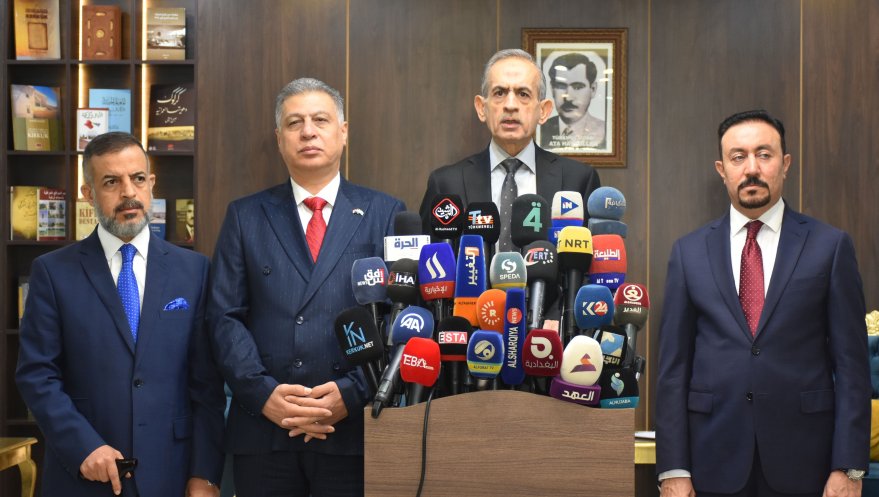
  • The Kirkuk representative of the Sadr Group Al-Sakri underlined that they want Kirkuk remained as attached to Bagdad. Al-Sakri said "Kirkuk is as important as our religion."
    The Iraqi Amir of Yazidis’ Anwar Muawiya İsmail explained that especially since 2003, there has been a great pressure on Yazidis, most of whom live in Mosul.
    ISCI Kirkuk Representative Necad Huseyin Hasan expressed that their own wish was to see Turkey more powerful in the region.
    Selahaddin Provincial Council's General Secretary Niyazi Mimaroglu, stated that they owe their success to serving to all the public by not discriminating.
    The Governor of Salahaddin province Abdülcabbar El-Kerim said “This province always welcomes the Turkish investors.”
    Ali Hasim Muhtaroğlu told that the political successes of the Turkmen in the Salahaddin Province increased enormously in the recent years.
    Usame Dede said that the Turkmen living in Diyala recently started to have more self-confidence and to be more active in the local politics.
    Basil El Gureyri, the vice president of the Center for Iraq Strategic Studies shared his assessments on the Iraq Elections
    Azad Chalak, executive editor of Rozname, which is close to Goran, attributed Goran’s failure to underutilizing nationalist rhetoric.
    The chairman of the executive board of the Turkish-Kurdish Friendship Association, based in Arbil, Shivan Taveng claimed that if Turkey wants regional power, its best leverage is the Kurds.
    Iraqi Vice President Adil Abd Al-Mahdi answered ORSAM's questions on Iraq’s main problems, domestic politics and election issues.
    Alon Ben-Meir, Professor of International Relations, has answered ORSAM's questions regarding recent Middle East politics and Turkey's role.
    In the interview with Aude Sgnoles, the municipal governance in Gaza and the causes of Hamas' success were discussed.
    Meeting with the Iraqi Turkish Teachers
    On the meeting, there was an exchange of ideas on the troubles in the education system.
    Iraqi Bektashis in ORSAM
    The current position of Bektashi community, their problems and the possible solutions were handled.
    Decision of Cooperation Between Baghdad University and ORSAM
    Delegations exchanged views about academic cooperation and joint activities.
    American House of Delegates Members and Senators at ORSAM
    The American Delegation from Virginia and Maryland received a briefing on Turkey-US relations.
    ORSAM-IAMES Meeting
    The sides decided upon having joint studies on the Middle East and Turkey-Vietnam relations.
    The Final Communiqué of the Turkey-Iraq Relations Symposium Has Been Declared:
    "Let's rewrite the history of the Middle East together"
    The First Turkey-Yemen Forum was Held
    The Forum in Istanbul was organized by The Ministry of Foreign Affairs, ORSAM and İTO.
    The Full Text of Iraqi Kurdish Regional Government's President Massoud Barzani's Speech at ORSAM on 4 June 2010
    ORSAM Hosted UN Iraq Special Representative Ad Melkert
    Melkert said that Turkey is a constructive model for Iraq.
    A critical look at the still shallow Turkish-Arab rapprochement
    Hasan Kanbolat, ORSAM Director
    It is a reality that for the past few years relations between Turkey and the Arab world have been developing in a rapid and multidirectional manner. Yet when we examine this Turkish-Arab convergence closely, we can see that it has yet to yield results and still has not taken firm root.
     
    The high-level political convergence, the support for it on the Turkish and Arab streets and mutual visits by businesspeople don’t seem to be enough to secure a deeply rooted union. Outside of the flow of hot money from the Gulf countries, the Turkish-Arab rapprochement has not yet led to an increase, outside of the norm, in the foreign trade volume between Turkey and the Arab nations. As it is, the rapprochement in question has not led to an increase in projects for Turkish contractors in Arab countries. In the Middle East’s main sector, energy, Turkish energy firms have also not seen increased projects or contracts. In sectors Turkey is strong in, such as food, automotives, textiles and communications, Turkish investment has not yet begun in the Middle East, either.
     
    The banking system between Turkey and the Arab countries is also in a rather bad condition. Turkish businesspeople working in Arab countries generally have to use European bank branches in Arab countries to handle their business with Turkey. As for Turkish banks, they don’t know the Middle East at all; they are just beginning to enter the area, and are not very driven to learn about the region. They act with hesitance when it comes to entering the Middle East. Turkish banks opening branches in the Middle East have only done so to ensure they have a presence in the region. For this reason, they usually assign their least talented staff to their branches in Arab countries. In addition, from commercial law to legal infrastructure, the work done to pave the way for a convergence between Turkey and Arab countries is still insufficient.
     
    The warm interest the Arab public has shown in getting to know Turkey has yet to see reciprocation on the Turkish side. While Arabs travel to Turkey and watch Turkish serials, Turks who embrace the Turkish lifestyle, culture and music still don’t exhibit similar warmth towards Arabs and Arab countries. While Arabs are fast erasing anti-Turkey and anti-Turkish prejudices from their memories, Turks aren’t progressing at the same speed.
     
    Turkish and Arab intellectuals, political movements, youths, academics, civil society organizations and bureaucrats have yet to get to know each other and come together. And there are no mechanisms to bring them together. There is also no support for Turkish-Arab rapprochement coming from the states on either side, international organizations or the private sector. For example, there are hundreds of different mechanisms and sponsoring establishments to ensure Turkish-Greek, Turkish-Armenian and Turkish-EU convergence, but none to support Turks and Arabs drawing nearer to one another. The second reliable source for Arab intellectuals, opposition members and businesspeople is the EU and the US -- not Turkey, yet. In particular, while leftist Turkish intellectuals view Turkish-Greek or Turkish-Armenian rapprochement as “progressive,” they view Turkish-Arab rapprochement as “backwardness” and don’t look sympathetically upon it. Getting to know the Middle East is not yet amongst the dreams of Turkish youth; living or studying in the EU or US is. While Turkish academics have gained an interest in learning Russian with other Western languages -- English, French, Italian, German and Spanish -- they don’t have the same interest in Arabic. There are only around 10 academics, strategists and think-tank members in Turkey who specialize in the Middle East. And these academics and strategists don’t know Arabic or Hebrew or Farsi. They follow the Middle East through English-language sources and generally have completed their doctorates in the United States. The only country in the Middle East in which they have spent long periods of time is Israel, for scholarship opportunities are abundant there.
     
    Turks only know the Middle East through the “problem of Palestine”; they are not concerned with other problems. In Turkey all the political movements and groups, from the far right to the furthest left, have espoused the Palestinian cause. The Turkish intellectual who will stand up for even one wounded Palestinian in Gaza or the West Bank does not show the same level of sensitivity in the face of flowing blood in other parts of the Middle East. For example, Turkish intellectuals aren’t interested in the average 100 people who die in Iraq every day in terrorist attacks, the 1.5 million people who lost their lives in Iraq between 2003 and 2010, or the more than 1 million widows and roughly 3 million orphans in the same country. This painful reality hasn’t led to popularity in Turkey for the Iraqi flag, as is the case with the Palestinian flag.
     
    In short, while Turks and Arabs are drawing closer together with zeal, they must at the same time develop infrastructure, strategies and mechanisms for this convergence other than populism. Otherwise when someone blows the whistle, the friendly game might be over.
     June 22 2010
              
    03 September 2010 (ENG / TR)
    02 September 2010 (ENG / TR)
    01 September 2010 (ENG / TR)

    ORSAM Report No: 18

    FROM NEIGHBORHOOD TO STRATEGIC ALLIANCE:
    TURKISH-RUSSIAN RELATIONS
    (Tr-Русский)

    ORSAM Report No:17

    EVALUATION OF 7 MARCH 2010 IRAQ PARLIAMENT ELECTION RESULTS AND THE NEW POLITICAL EQUATION
    (In Turkish)

    ORSAM Rapor No: 16

    SULTANATE OF OMAN :
    A COUNTRY ON THE ARAB PENINSULA CAUGHT BETWEEN TRADITIONALISM AND MODERNITY
    (In Turkish)

    ORSAM Report No: 15

    OBSERVATION REPORT OF ORSAM DELEGATION ON 
    7 MARCH 2010 IRAQI ELECTIONS 
    (In Turkish)

    ORSAM Report No. 14
    POLITICAL SITUATION IN IRAQ DURING THE PRE-ELECTORAL PERIOD AND EXPECTATIONS REGARDING THE ELECTION

    (In Turkish)

    ORSAM Report No. 13
    AN ANALYSIS ON THE POLITICAL STANCE OF THE SHIITE PARTIES AND THE VOTERS, BEFORE THE MARCH 7 ELECTION IN IRAQ
    (In Turkish)

    Report No. 12
    THE INFLUENCE OF THE FACTOR OF IRAQ ON TURKEY’S MIDDLE EAST POLICIES (1990-2008)
    (In Turkish and Russian)

    ORSAM Report No. 11

    THE FORGOTTEN TURKS: TURKMENS OF LEBANON

    ORSAM Report No. 10

    CIVIL WAR IN YEMEN: THE POWER STRUGGLE, REGIONAL INFLUENCES AND RELATIONS WITH TURKEY

    ORSAM Report No. 9

    THE YEMEN ISSUE:
    A STEP TOWARD REGIONAL WAR?

    ORSAM Report No. 8

    ABKHAZIA FOR THE INTEGRATION OF THE BLACK SEA 

    ORSAM Report No. 7

    THE FORGOTTEN TURKMEN LAND: DIYALA

    ORSAM Report No. 6

    THE TUZHURMATU TURKMENS: A SUCCESS STORY

    ORSAM Report No. 5
    TURKEY - LEBANON RELATIONS: PERCEPTIONS OF TURKEY AMONG THE RELIGIOUS AND SECTARIAN FACTIONS IN LEBANON
     

    ORSAM Report No. 4

    2009 LEBANON ELECTIONS: WINNERS, LOSERS AND TURKEY
    (In Turkish)

    Home Page    |    Subscribe    |    Contact    |    Press    |    Site Map    |    Links    |    Rss